



Most read articles
| 1 | The client, the unknown entity – understanding client requirements |
| 2 | Goodbye typical legal career? |
| 3 | The client, the unknown entity – understanding client requirements |
The first step in my small series about client orientation is entitled “A better understanding of client requirements”. But then, why waste any ink on this? After all, we lawyers know all about that. Clients require us to provide them with professional, legally correct advice concerning a legal issue or with a juridically flawless representation in a legal dispute. That’s it – or maybe not?
First the good news: of course it’s important for us to do our legal work as well as possible. The purchasers of legal services expect us to. But the question is: was that all, or is there more to it?
Countless studies have recently been dealing with the question of the expectations our clients have of our work. The results of this research can be easily mapped along the so called means-end-chain (please click for a picture).
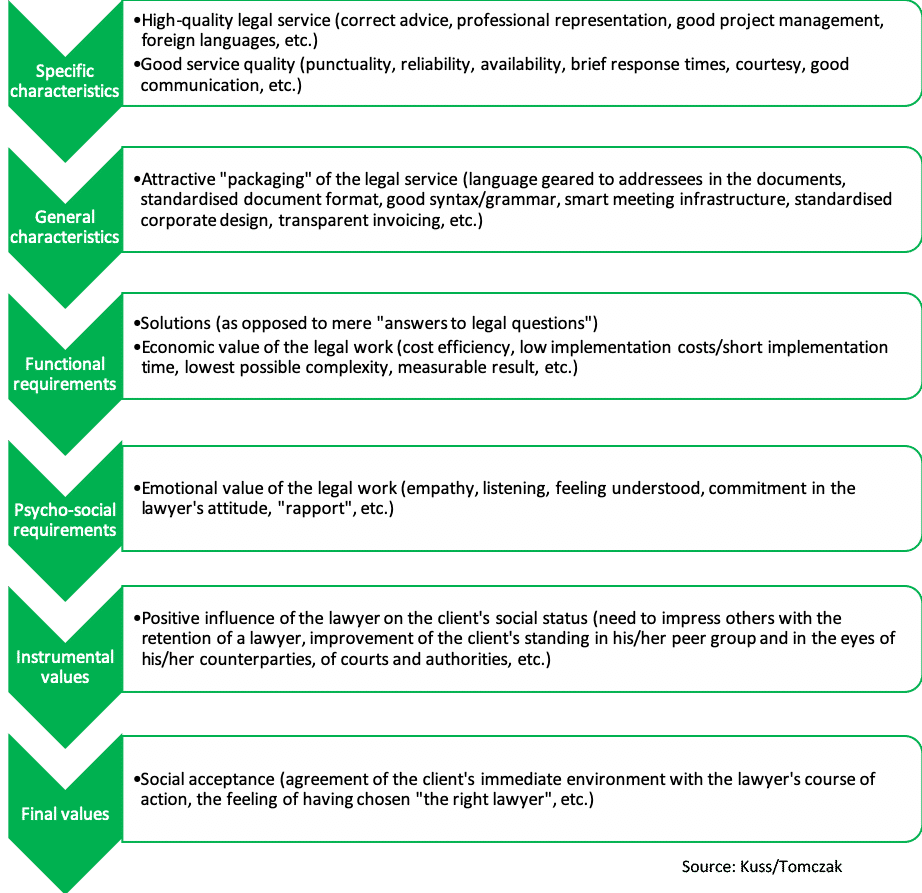
Naturally it does not come as a surprise that besides the legal quality of a lawyer’s work, other, soft factors also play a part for our clients. What does come as a surprise, though, are the two following things:
1) When it comes to the assessment of our service by clients, the soft factors (“packaging”, solution orientation, emotional value, improvement of their standing and social acceptance) play a much greater role than the legal core service. Yet when all is said and done, this is also hardly surprising: the vast majority of clients are in no position whatsoever to evaluate a lawyer’s work in purely technical terms.
Executive School Programmes:
Law & Management
Management for the Legal Profession
Business administration skills for lawyers subsequent to the EMBA
2) The provision of the minimum legal service (correct legal advice) only results in a situation whereby the client is not dissatisfied. Clients are only satisfied or even enthusiastic when a service meets their other requirements or even exceeds their expectations.
In my next blog post, we’ll go a step further and talk about whether the creation of client segments for the improvement of a law firm’s client orientation makes sense and how this is brought about.
Image Source: Istockphoto